
By Capt. Jackson L. Ritchie, JLR Maritime Consultants
I’ve lived through nearly seven decades of change in The Bahamas, including roughly 30 years living and doing business in Freeport. As Harbour Master, I helped expand the port for larger cruise ships. I founded Tanja Enterprises, helped establish MSC Bahamas and later led Global United. Today, through JLR Maritime Consultants, I advise on maritime development. As a Senior Director at Young America Capital, I also help businesses and project sponsors raise debt and equity capital across the Caribbean and internationally, with a particular focus on maritime, infrastructure, transportation and energy, alongside opportunities across other industries. I’ve seen what Grand Bahama can do from the ship’s bridge, as a Bahamian employer and across the table from investors.
Grand Bahama should be the shining star of the region. The distance between its potential and what it has delivered for its people is one of the biggest disappointments of my lifetime. The population fell between the 2010 and 2022 censuses, and overnight visitors declined from nearly 587,000 in 1995 to about 101,000 in 2025. Yet Grand Bahama Shipyard has just completed a US$600 million expansion. The same island that has struggled to keep people and businesses has delivered a project that puts Freeport in a position to compete for some of the most demanding ship repair work in the Americas.
Grand Bahama Green Paper · Grand Bahama Shipyard expansion
Freeport has an identity problem
In my view, our biggest strategic mistake has been trying to make Freeport another Nassau. For too long, governments and other stakeholders have looked to the next resort, casino or hotel redevelopment to turn the island around. The long struggle to revive the Grand Lucayan shows the cost of putting so much weight on a single tourism property. Nassau has an established tourism economy of its own. Freeport grew around a deep-water harbour, industrial land and the ability to serve commercial customers across borders. Those strengths should guide what we build, whom we recruit and how we judge progress.
The Tribune on the Grand Lucayan redevelopment
Look at what Grand Bahama has already built. Freeport Container Port became a transshipment hub. The Bahamas Oil Refining Company (BORCO), now the Buckeye Bahamas Hub, and the South Riding Point (SRP) energy terminal near High Rock brought international petroleum storage and shipping to opposite ends of the island. Bahama Cement was an early industrial anchor. The former Syntex chemical and pharmaceutical plant, later operated by PharmaChem, demonstrated that Freeport could handle sophisticated manufacturing. PharmaChem began winding down in 2024. That loss should prompt us to ask what it would take to attract the next generation of manufacturers and keep skilled industrial jobs on the island.
Freeport Container Port history · Bahama Cement’s 1962 Act · BORCO and the Buckeye Bahamas Hub · South Riding Point · Syntex and PharmaChem history · PharmaChem’s statement on winding down
Grand Bahama can build a tourism model of its own around the cruise industry. Carnival’s Celebration Key opened in July 2025 and welcomed 2.4 million guests in its first year, according to Carnival. The Government says MSC’s Freeport plans include harbour upgrades, a new cruise terminal at Billy Cay and a beach club at Lucaya. Royal Caribbean Group’s proposed cruise destination at the former Xanadu Beach Hotel adds another opportunity. The Tribune reported that Royal Caribbean acquired the hotel site in 2026.
Carnival’s first-year Celebration Key results · MSC’s Billy Cay cruise terminal and beach club · Royal Caribbean’s Xanadu project
Grand Bahama’s opportunity is to serve both the passenger and the fleet. Give visitors reasons to spend time and money with Bahamian tour operators, restaurants and shops beyond the cruise properties. Give the same cruise lines reasons to provision in Freeport, change crews here and send ships here for repair and refit. Ask each operator what it will buy locally, which contracts Bahamian businesses can compete for and what training it will support. Judge the results by how much visitor spending reaches local communities, how much fleet business stays on the island and how many year-round jobs it creates.
The first step is some honest self-reflection. A place has to recognise what it does well before it can decide what to become. Grand Bahama’s record points to a maritime and industrial centre with tourism that can grow alongside it. Once we accept that, the priorities become clearer. Recruit companies that will put operating teams here, prepare industrial sites with reliable utilities and train Bahamians for the work those employers need. Judge the strategy by year-round jobs, exports and recurring contracts won by local companies.
Put the world’s largest economy to work for Grand Bahama
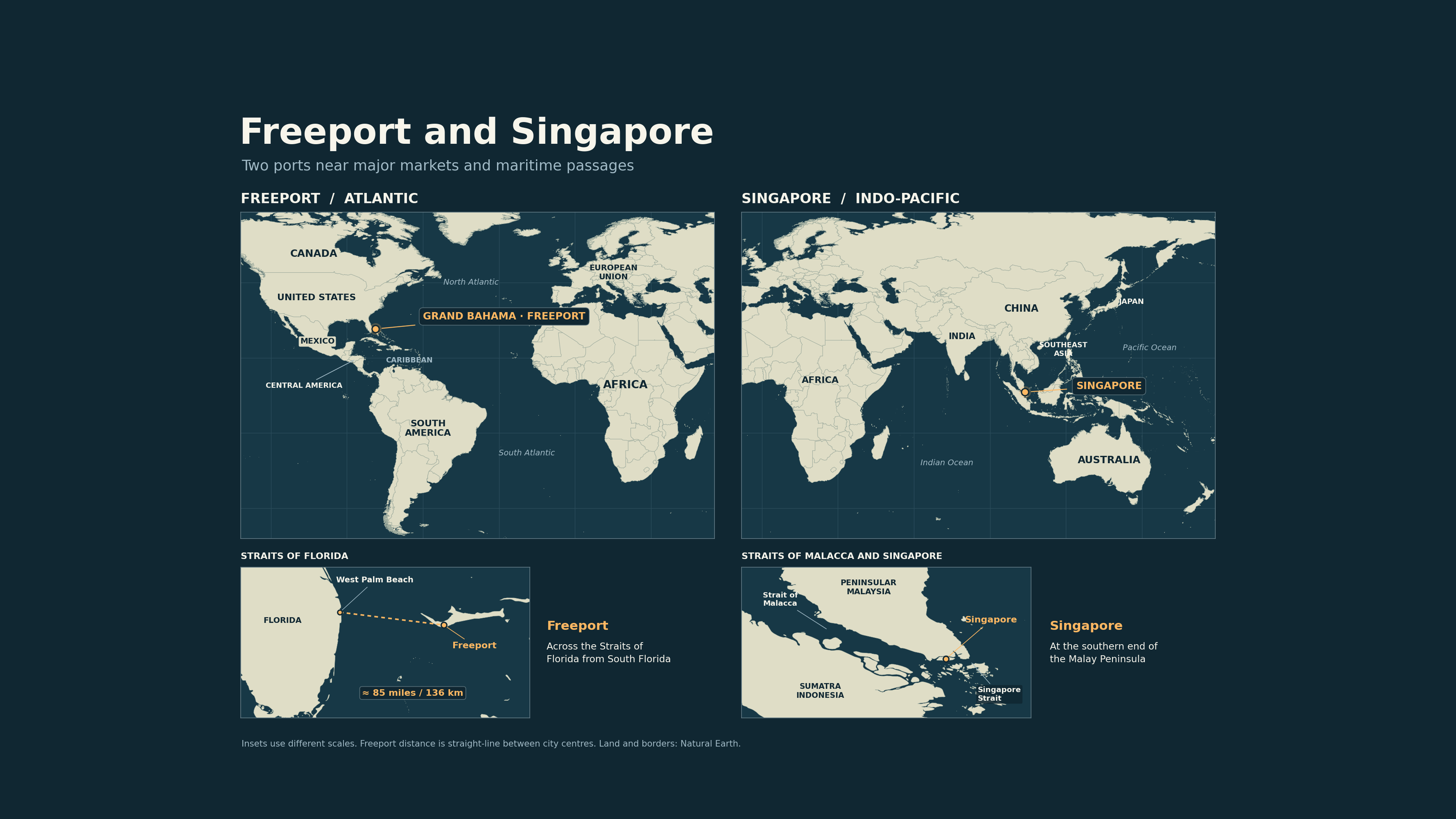
Freeport sits about 85 miles from West Palm Beach, across the Straits of Florida from the United States, the world’s largest economy by nominal GDP. South Florida already has cruise headquarters, fleet suppliers, engineering firms and freight networks. We can give companies serving those customers a reason to put teams and inventory in Freeport. A ship that needs an engine specialist or a critical spare should be able to find both here. A fleet scheduling maintenance should be able to arrange a crew change, load provisions and get the vessel back into service from the same port.
World Bank GDP by country, current US dollars
Start with the fleets using Grand Bahama. Ask Carnival and Royal Caribbean what repair, retrofit and equipment work they would buy on multi-year contracts if we could deliver it here. Take that demand to suppliers such as Wärtsilä and Everllence PrimeServ and ask what would justify a certified workshop, a spares depot and a Bahamian training programme. Ask MSC and other carriers what it would take to base more procurement and logistics in Freeport. Bring Bahamian ship agents, food distributors, medical providers, truckers and tradespeople in early enough to win work and build businesses of their own.
Grand Bahama Shipyard’s local agents · Wärtsilä workshop services · Everllence PrimeServ
What Singapore built with its success
Singapore used its port as the foundation for an economy that also earns from manufacturing, finance and logistics. It recruited global companies, prepared industrial sites with shared utilities, simplified ship clearance and invested in skills. Singapore’s nominal GDP per person was about US$98,800 in 2025. Decades of investment, productive businesses and public saving also gave it the means to build national wealth that benefits successive generations.
World Bank data for Singapore · JTC industrial infrastructure
Its institutions have distinct jobs. GIC invests government reserves for the long term. The Monetary Authority of Singapore, its central bank, manages official foreign reserves. Temasek Holdings is a state-owned commercial investor. It reported a net portfolio of S$518 billion at 31 March 2026. Temasek wholly owns global port operator PSA International, holds a majority stake in ST Engineering and has a substantial stake in DBS Group. Those businesses compete commercially while Singapore retains a stake in the value they create.
Singapore Ministry of Finance on reserve management · Temasek portfolio and holdings · Temasek portfolio value
Residents benefit through the national budget. Singapore’s rules allow it to spend up to half the expected long-term real returns on the relevant net assets. Its Ministry of Finance estimated a S$28.48 billion contribution for fiscal year 2026, roughly one-fifth of annual government spending. That gives Singapore room to pay for education, healthcare and infrastructure while retaining part of the returns for future generations.
Singapore’s investment returns framework · How Singapore uses its reserves
There is a Bahamian lesson here. When public land, infrastructure or concessions help make a commercially viable project possible, negotiate a fair share of the long-term value where the economics justify it. That could be ground rent, a revenue share or a minority equity stake. Publish the terms, including what the public puts in and what it stands to earn. Over time, a transparent share of realised proceeds could be reinvested in technical training, storm resilience and the infrastructure that makes the next investment possible. First we have to earn the returns by building businesses and assets that people will pay to use.
Connect the opportunity to the capital
Grand Bahama’s next chapter will require investment in businesses as well as major infrastructure. A Bahamian marine contractor buying equipment, a food distributor expanding cold storage, an engineering company establishing a workshop and a developer building energy or water infrastructure all need financing suited to their customers, contracts and stage of development.
Attracting that capital takes more than promoting the island’s potential. Investors and lenders need credible sponsors, clear ownership and approvals, realistic costs, evidence of demand and a practical route to repayment or investment returns. Helping local businesses prepare for that scrutiny should be part of Grand Bahama’s development strategy.
This is one area where I can contribute directly. Through Young America Capital, I work with businesses and project sponsors to assess financing options, prepare their investment case and pursue suitable debt and equity investors regionally and globally. That work includes maritime, infrastructure, transportation and energy projects, as well as growth businesses across other industries. Through JLRMC, I can also help connect maritime opportunities with the operating expertise and industry relationships needed to move them forward.
For business owners and sponsors reading this, the starting point is a clear account of what you want to build or expand, how much capital you need and how the business will earn its return. Where there is a credible commercial opportunity, I welcome a conversation about how we can help prepare it for financing and connect it with appropriate partners. You can contact me through JLRMC or schedule an introductory conversation.
Grand Bahama already has people with the ambition and experience to build valuable businesses. Giving more of them access to expertise, customers and suitable capital would turn the island’s advantages into enterprises that employ Bahamians and keep earning here.
Give Grand Bahama a team that can deliver
Hurricanes took a devastating toll. We made recovery and reinvestment harder by leaving too much uncertainty over who decides, who pays and who delivers. We have been too willing to celebrate a major announcement before asking which local companies will win work, which Bahamians will be trained to run it and when the roads, power or airlift will be ready. Residents who put the airport, hospital and essential services first are asking exactly the right questions. Give each priority a named lead, a budget and a public date for the next milestone.
IDB assessment of Hurricane Dorian · Early consultation feedback reported by The Tribune
Stephen Crane argues for an independent plan with “agreed five, ten and 50-year milestones that are published and measured.” I agree. The Government, GBPA, landowners, operators and communities should agree on what Grand Bahama is building, then put a qualified chief executive in Freeport with a budget, deadlines and a board that can hold that person to account. Bring in the Grand Bahamians who have built businesses and run operations, including those working abroad. Ask them to open doors to customers, mentor local owners and help create paid routes for younger Bahamians into the trades and into management.
Stephen Crane’s article in The Tribune
The next generation should be able to build a company in Grand Bahama that sells to the world, or build a career here that would once have required leaving. Freeport’s path to becoming the Singapore of the West begins with recognising the maritime and industrial city we already built and deciding to build on it. If you know what has held Grand Bahama back, put it on the record. If you can help build what comes next, say what you are prepared to do. The consultation runs through 30 April 2027.
Respond to the official consultation · Read the Green Paper · My earlier Bahamian maritime white paper