
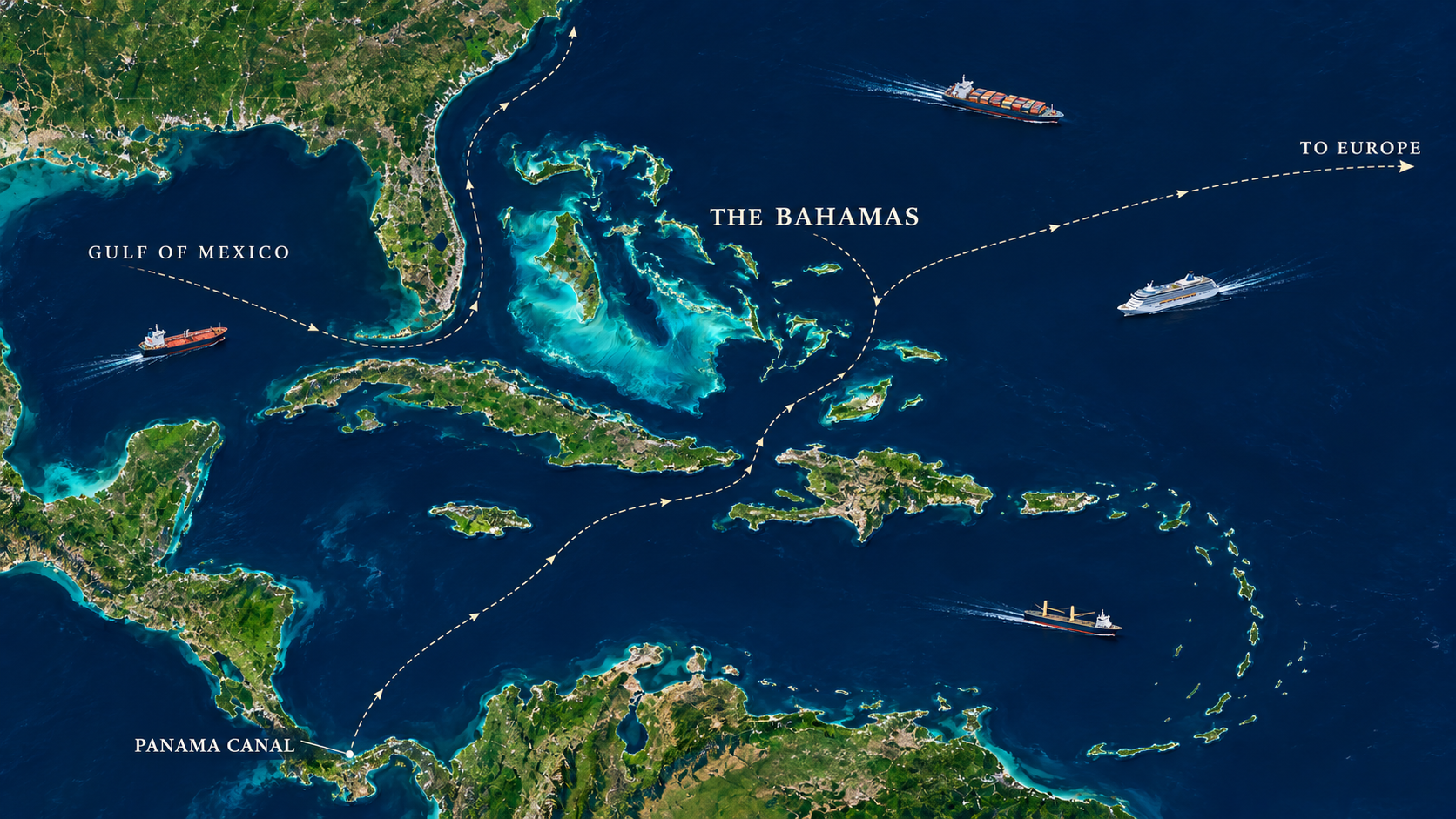
The Bahamas as a Global Maritime Hub
A 2035 vision for making maritime a leading pillar of the Bahamian economy
JLR Maritime Consultants | White Paper | November 2026
Bring global maritime operations to The Bahamas
By 2035, The Bahamas should be a first-choice Atlantic operating base for maritime companies serving the Americas. Cruise and cargo lines should be able to manage fleets from Nassau, dock and refit vessels in Freeport, source parts and services from Bahamian firms, and recruit trained Bahamian crews. Yacht operators, equipment manufacturers, financiers and insurers should see enough business here to establish permanent teams and facilities of their own.
The Bahamas already has a route into the boardrooms that make those decisions. The Bahamas Maritime Authority describes the country as the leading flag for passenger ships, and UN Trade and Development ranked the Bahamian-flagged fleet fourth worldwide by value as of 1 January 2025. The next step is to ask fleet owners where they spend money, which operations they could move to The Bahamas, and what would make the economics work. Singapore offers a useful precedent for building a maritime business centre around a port and a broad base of service providers. [1] [2] [3]
What to bring to the country
Regional fleet headquarters and operating teams. Recruit cruise lines, container carriers, ship managers and yacht operators to base technical management, procurement, crewing, safety and fleet support in Nassau or Freeport. Use registry relationships to reach decision-makers. Seek commitments for local teams, supplier contracts and cadet berths alongside each investment.
Ship repair, refits and marine manufacturing. Build around Grand Bahama Shipyard’s expanded dry-dock capacity. Recruit equipment manufacturers and specialist contractors to establish certified repair shops, spare-parts depots and training facilities. Target multi-year fleet service agreements that give Bahamian firms the demand to invest in fabrication, marine electrical systems, propulsion, refrigeration and coatings. [4]
A regional cargo and marine services gateway. Market Freeport’s deepwater container and industrial facilities to carriers, logistics operators and offshore service companies. Pursue service agreements for transshipment, project cargo, bonded spares, cold-chain distribution and vessel supplies. Tie major capacity additions to contracted traffic. Expand shore power, emissions-reduction retrofits and other cleaner vessel services where fleet customers can support them. [5]
Build one industry across the islands
Freeport. Anchor heavy repair, refits, marine equipment service, industrial logistics and cargo. Make space, reliable power and multi-year customer contracts available for suppliers to establish permanent operations.
Nassau. Attract fleet headquarters and maritime finance, insurance, legal and claims teams. Expand cruise provisioning and crew logistics. Pursue selective homeporting where berth access, airlift and ground handling support it. [6] [7]
Abacos, Bimini and Exuma. Develop a connected yacht service network, with repair and storage in the Abacos, South Florida access through Bimini, and charter support and provisioning in Exuma. Agree standards for moorings, waste handling and habitat protection. [8] [9] [10]
Great Inagua and Mayaguana. Use Inagua’s salt-export activity to grow maintenance, fabrication and marine logistics. Use Mayaguana’s announced port partnership to secure dependable resident freight and opportunities for local suppliers. Pursue larger terminal phases when customers, approvals and financing are in place. [11] [12]
Long Island and the eastern and southern islands. Test scheduled freight and cold-chain service through Clarence Town or Salt Pond, then extend services where volumes support them. Cat Island, Acklins and Crooked Island can build around local fisheries, small boats and visitor services. San Salvador and Rum Cay can develop research and dive services. On smaller routes, prioritize safe landings, dependable power and essential freight. [13] [14] [15] [16]
Make The Bahamas competitive as an operating base
International operators will compare the cost and reliability of doing business across jurisdictions. Publish service standards and timelines for port clearance, customs and investment applications. Coordinate agencies through a single investor contact and apply interoperable digital clearance consistent with the IMO Maritime Single Window framework. Assess proposed incentives against permanent employment, local purchasing and actual capital deployed. Give shipowners a reason to renew contracts after any incentive expires. [17]
Build a workforce that can move from paid apprenticeships and sea time into licensed, technical and management roles. Link training intake to employer commitments. Expand the shipyard apprenticeship model and work with Bahamian maritime and technical institutions to train crews and tradespeople for the work investors will bring. [18] [19] [20]
Turn the vision into investment
First year. Assign a government lead and bring ports, industry, finance, training institutions and island representatives into one delivery programme. Build a list of international fleet owners, equipment suppliers and logistics firms to recruit directly. Prepare site, capacity and utility information for investors, publish the first Bahamian supplier opportunities, and design a freight pilot for the southern islands.
Years two to five. Negotiate anchor operating agreements, advance port and utility investments supported by demand, and scale workforce programmes with employers. Use public and development finance for essential links, coastal resilience and project preparation. Use commercial capital for assets with paying customers and credible operators. The IDB, Caribbean Development Bank and Green Climate Fund provide relevant precedents for shared infrastructure. IDB Invest and IFC-backed regional capital provide precedents for private projects. [15] [16] [21] [22]
Proposed 2035 benchmarks. Attract 10 new or materially expanded international maritime operations with permanent local teams or facilities. Qualify 100 Bahamian suppliers and track which win recurring work. Deliver 500 paid apprenticeships or supervised sea-time placements cumulatively. Set baselines in year one, then publish annual results for investment, Bahamian wages, maritime exports, supplier spending and freight reliability. These are proposed targets for discussion.
The lasting prize is an industry that exports year-round, creates routes into higher-paying work and gives Bahamian firms access to global customers. Tourism gains stronger cruise and yacht services, finance gains a new base of operating clients, and the Family Islands gain better access to customers and supplies.
References
- Bahamas Maritime Authority. Seatrade Cruise Global 2026
- UN Trade and Development. Review of Maritime Transport 2025, tables II.2 and II.4
- Maritime and Port Authority of Singapore. International Maritime Centre
- ZNS Bahamas. Grand Bahama Shipyard expansion completion
- Freeport Container Port. Terminal and capacity
- Nassau Cruise Port. 2025 passenger and call totals
- Bahamas Maritime Authority. Ship mortgage registration
- Bahamas Ministry of Tourism. Abacos marinas and boatyards
- Baleària Caribbean. Bimini and Fort Lauderdale ferry
- Bahamas Ministry of Tourism. The Exumas
- Liwathon Group. Lusca Salt operations and Man of War Bay export dock
- Office of the Prime Minister. Port at Mayaguana public-private partnership
- The Tribune. South Long Island mailboat service
- University of The Bahamas. Gerace Research Institute
- IDB. Climate Resilient Coastal Management and Infrastructure
- CDB. CDB and GCF climate-resilient water financing agreement
- International Maritime Organization. Maritime Single Window
- LJM Maritime Academy. Programmes
- Bahamas Technical & Vocational Institute. Programmes by island site
- Grand Bahama Shipyard. Paid apprenticeships and Liverpool training
- IDB Invest. Grand Bahama Lucayas solar project
- IFC. Investment in the Caribbean Community Resilience Fund debt sub-fund